













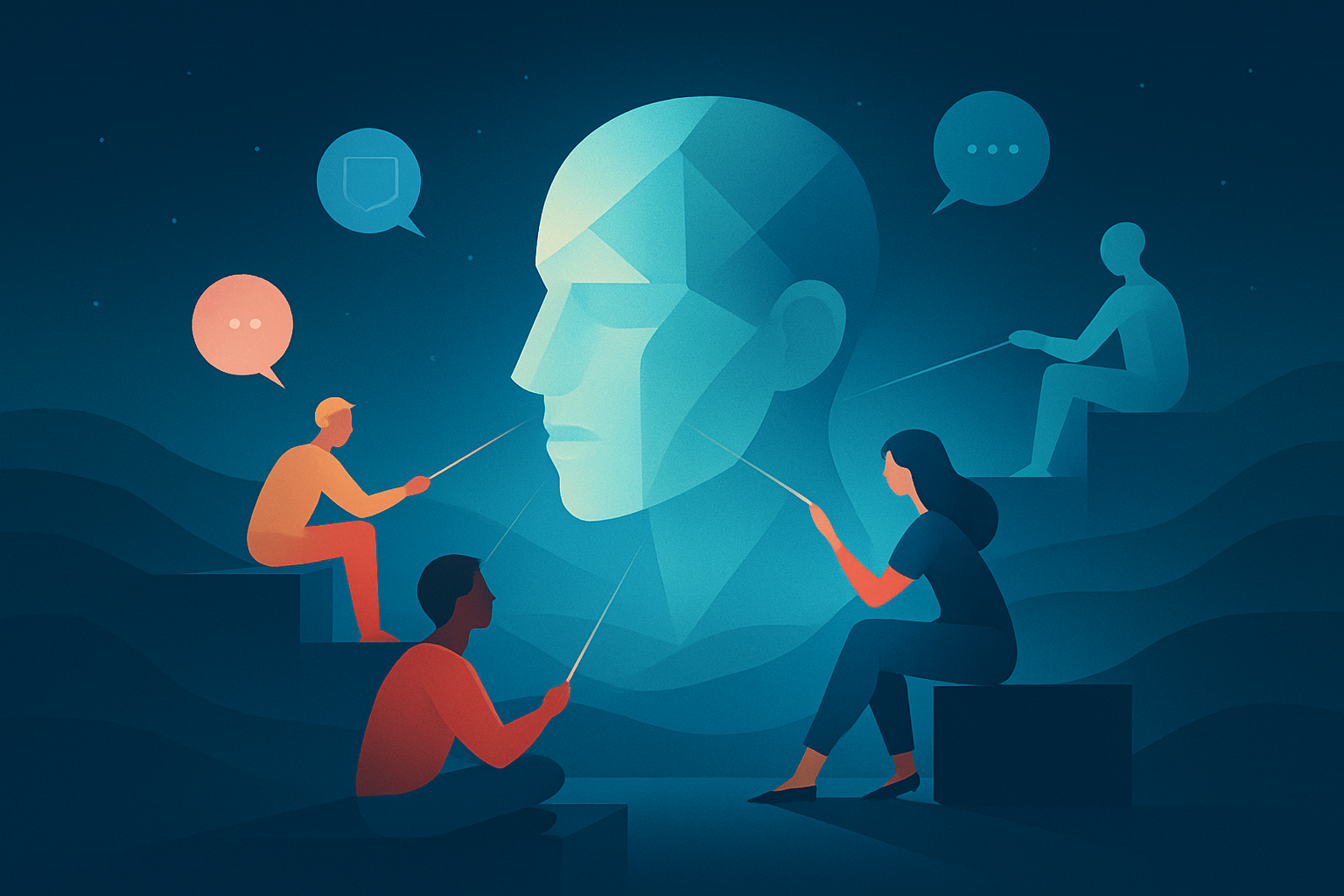

Three profiles in silhouette against a starlit teal sky — the personas at the table
CASE STUDY

Personas: Creating Space
At The Table

Creating the personas was my first mandate at VOSKER&SPYPOINT.

Company
VOSKER / SPYPOINT
Role
CX Designer & Strategy
Years
2023 — 2024

Chapter I

The Problem

What was wrong?

The company did not lack customer knowledge.

It had too many versions of the customer.

Product, Marketing, Sales, and Support each carried a different understanding of who the customer was, what they valued, and what they expected.

Each perspective came from real experience. But together, they did not form a shared picture.

Everyone was talking about the same customer.

They were not always speaking the same language.

  • Product

    What they need

  • Marketing

    What they value

  • Sales

    Why they choose

  • Support

    Where they struggle

Four department representatives—Product, Marketing, Sales, and Support—sit across the same meeting table. Each is labeled with a different perspective on the customer: what they need, what they value, why they choose, and where they struggle.
Four teams, four partial views of the same person.

The goal was not to merge these perspectives into one “average” customer. Each team saw the customer at a different moment in the experience—and therefore saw something real, but partial.

Instead, we needed to understand what each team was seeing, where their view was incomplete, and how those partial stories connected. Together, they could help us understand the customer more fully.

Chapter II

The Approach

How did I look at it?

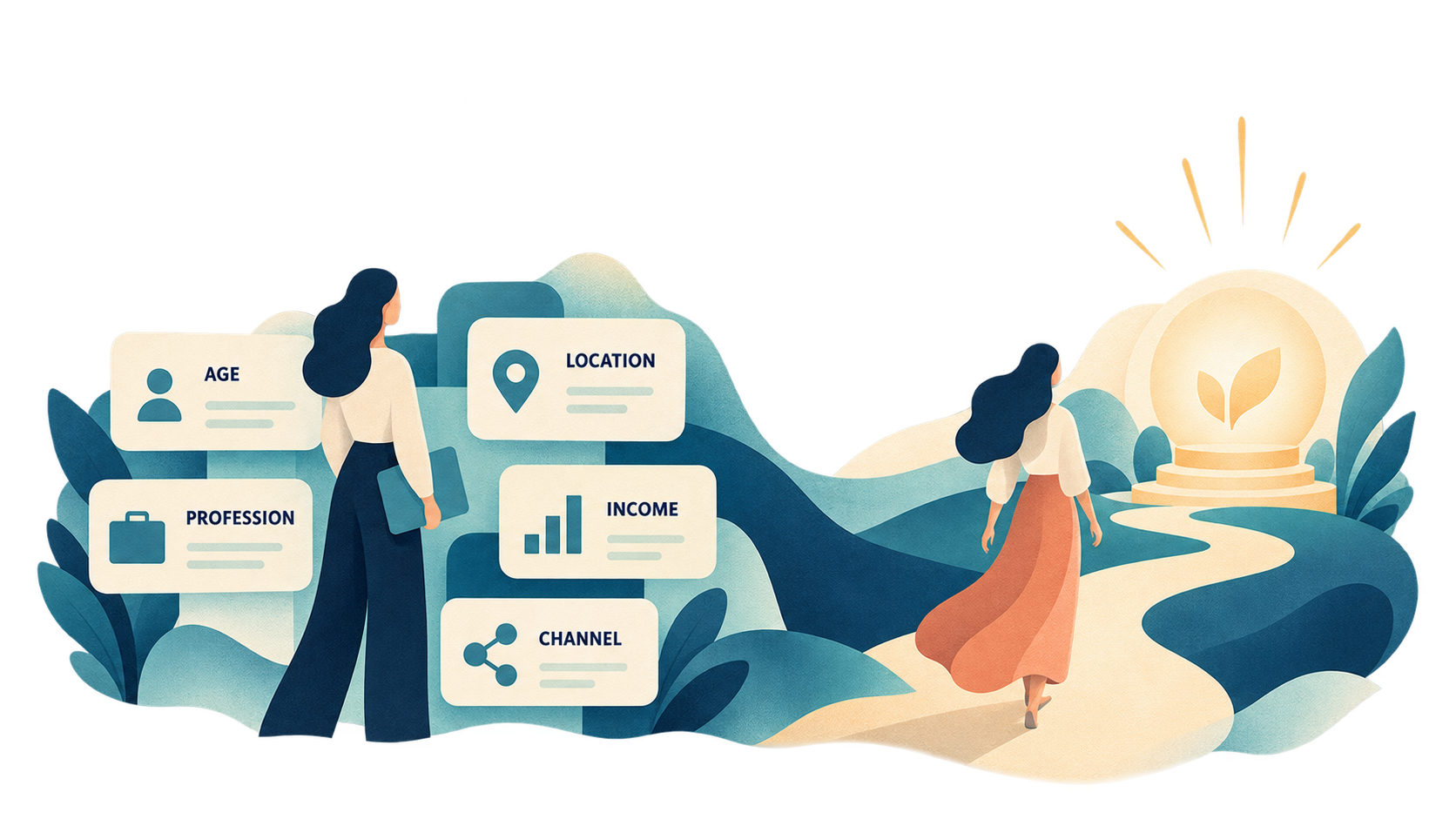
When building personas, there are plenty of familiar ways to divide an audience: age, location, profession, income, or channel.

  • Age
  • Location
  • Profession
  • Income
  • Channel

Those categories can tell us a lot about who people are on paper. But they do not always explain why two similar people can expect completely different things from the same product—or why it can play a very different role in each of their lives.

A split editorial illustration contrasts standard customer segmentation categories—age, location, profession, income, and channel—with a person's connection to a product.

Standard segmentation categories

Age
Location
Profession
Income
Channel

Product connection

We did not start with who they were.

We started with how they related to the product.

What were they counting on it to do?

What made it valuable to them?

What did they expect from the experience—and where did that relationship start to fall apart?

But even then, not every difference was worth building a persona around.

The useful differences were the ones that could change a decision: what to build, how to communicate it, or how to support the relationship around it.

That became our filter: not simply whether a difference existed, but whether understanding it could help the company respond differently.

Chapter III

From Signals to Focus

What did we decide?

01Signals

What we gathered—and what it revealed

We started with a wide field of evidence.

  • Internal perspectives
  • Customer interviews
  • Past surveys
  • Support logs
  • Reviews
  • Competitor messaging

Each source showed us something different: what teams believed, what customers said, where expectations broke down, and which patterns kept returning.

  • What teams believed
  • What customers said
  • Where expectations broke down
  • Which patterns kept returning

But collecting signals was the easy part.

The challenge was not finding differences.

It was deciding which ones mattered.

02Focus

What was useful enough to shape a decision

A pattern had to do more than describe a group.

It had to reveal a meaningfully different relationship with the product—and give the company a reason to respond differently.

The useful patterns were the ones that appeared across sources, changed what people expected or valued, and could guide decisions in the product, communication, or service.

  • Appeared across sources
  • Changed expectations or value
  • Could guide a decision

How the patterns were used

Some became personas, some informed relationships we wanted to develop, and some did not become personas at all.

Profile of a head with a heart inside it.

Clearly present

Some personas emerged clearly from the customers already using the product.

A faceted diamond.

Intentionally developed

Others represented relationships the company wanted to develop more intentionally.

A flowing directional arrow pointing outward.

Outside the framework

And some patterns did not become personas at all.

A persona was not only a description of who was there.

It was a decision about who the company was choosing to understand and serve more deliberately.

Chapter IV

Building It Together

How did we build it?

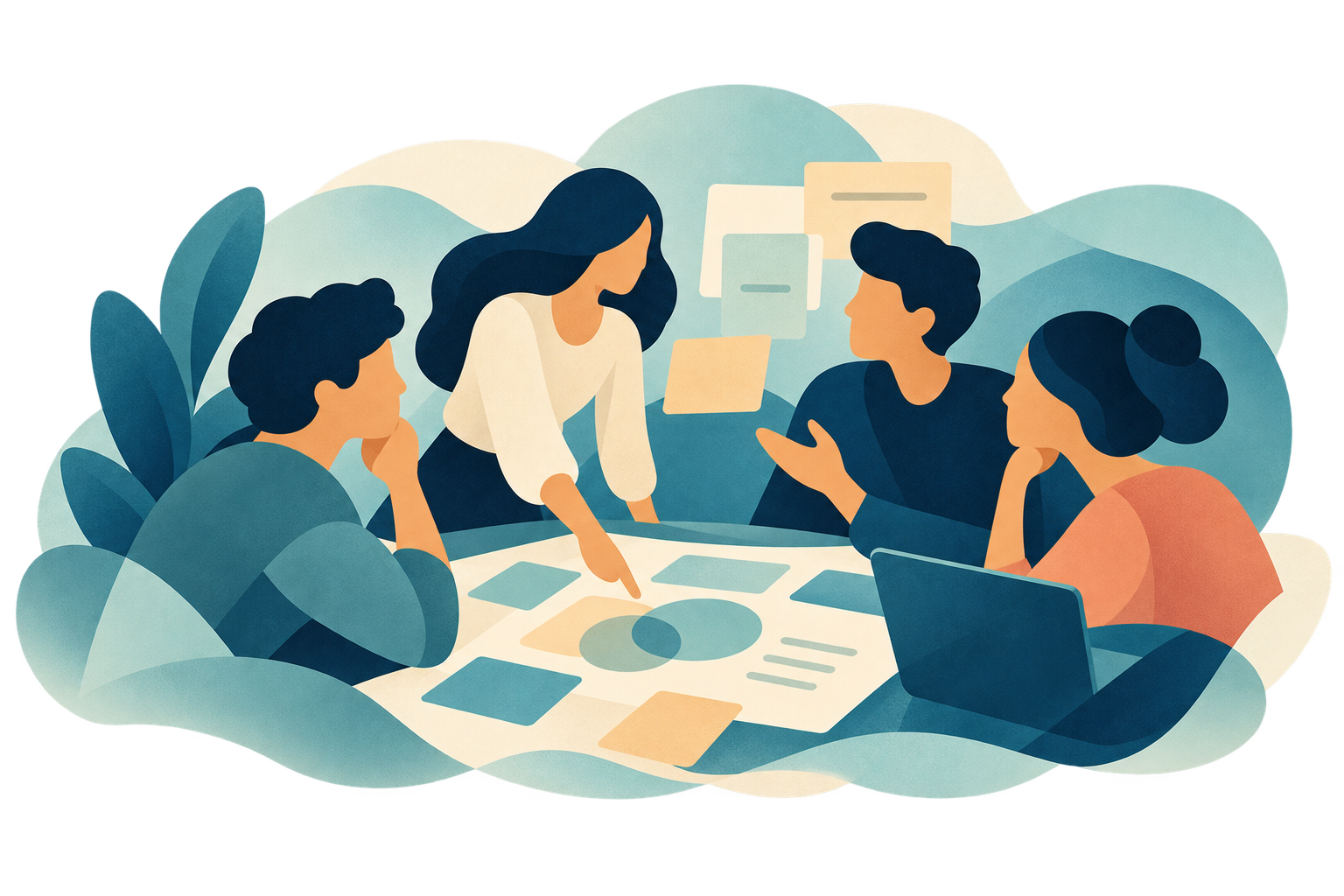
We ran a series of collaborative workshops with the CX team and cross-functional stakeholders to turn the research into a practical persona framework.

The workshops were not open brainstorming sessions. They were structured working sessions designed to test the evidence, challenge the emerging personas, and build shared ownership around the final framework.

01

We did not start from a blank page.

The workshops started with research, not opinions.

Each workshop began with evidence that had already been gathered, compared, and synthesized.

We brought recurring customer patterns, direct customer language, points of tension, and early persona distinctions into the room. The CX team and participating stakeholders worked from the same evidence base rather than creating personas from memory, assumptions, or personal experience alone.

02

We tested whether each persona held together.

A persona had to be internally coherent—not merely complete.

We mapped motivations, needs, pain points, and value points, but we did not treat them as four separate fields to complete.

We tested whether they supported the same underlying relationship with the product: what the person was trying to achieve, what made the product valuable, what they expected from the experience, and where that relationship began to break down.

Collaboration did not replace the evidence.

It helped us challenge it, refine it, and make it usable.

Three colleagues gathered around a table, studying a glowing laptop together.

Collaboration challenged the work. It did not replace rigor.

Stakeholder input was used to test the framework—not to vote on it.

CX team members and cross-functional stakeholders used their experience to question and validate the emerging personas.

We actively invited feedback from people whose experience did not immediately match the framework. Their disagreement helped us identify missing evidence, distinguish exceptions from recurring patterns, and revisit assumptions that had been treated as facts.

Disagreement improved the research. It did not dilute it.

Participation began the adoption process.

Ownership started before the personas were finished.

Because stakeholders helped test, question, and refine the framework, they did not encounter the personas later as a finished CX deliverable.

They had already seen how the distinctions were formed, why they mattered, and how the framework could support their own decisions.

Adoption was designed into the process, not added after delivery.

Chapter V

Bringing Personas to Life

How did we make them human?

We turned the validated framework into a set of recognizable persona profiles using names, visual identities, customer language, quotes, and short narratives.

The goal was not to invent complete fictional lives. It was to make each product relationship easier to recognize and remember.

01

The relationship came first. The character came second.

We started with what mattered in the relationship, not with facts about the person.

Before adding a name, face, or story, we defined the relationship each persona represented: the person’s goals, constraints, pains, expectations, and the deeper motivation that made the product matter to them at all.

That gave us the hierarchy.

Only then did we shape the persona’s characteristics. Demographic or biographical details were not the foundation. They were selected because they helped express what was critical about the product relationship.

From the relationship, we built the characteristics — not the other way around.

Tap the image to enlarge

Relationship with the product: Goals, Constraints, Pain points, Expectations, Motivation, Desired outcome.

Characteristics: Role, Age, Technical comfort, Financial context, Communication style, Daily context, Priorities.

02

We used customer language to keep them real.

Quotes and stories preserved how customers described value, expectations, and frustration in their own words.

We drew from recurring expressions and customer language already present in the research.

This helped teams hear the difference between how the organization described the experience and how customers actually understood it.


Customer language kept the personas grounded in lived experience.

03

Every human detail had to carry the story.

Once the persona’s story was defined, every humanizing element was selected to reinforce it.

Every detail had to do part of the work.

  • Name

    The name needed to evoke something about the character.

  • Face and visual identity

    The face and visual identity needed to reflect the emotional tone of the story.

  • Voice and language

    The way the persona spoke had to make their priorities and tensions recognizable.

  • Context and recurring cues

    Their living context, color palette, signature language, and recurring visual cues all had to point back to the same meaning.

This mattered because turning a complex customer relationship into something people could quickly understand and remember was difficult. A memorable persona could not depend on one strong paragraph or one good image.

The story gave each element its meaning—and each element helped the story stay memorable.

Chapter VI

Embedding in Culture

How did they become part of the way people worked?

We did not treat adoption as a one-time launch.

I created the materials, facilitated the sessions, and designed a long-term activation strategy that brought the personas into recurring moments across the employee and project lifecycle.

Different moments required different levels of detail.

I translated the framework into materials for quick reference, deeper understanding, comparison, and active use.

I created a layered set of materials so teams could access the right level of information for the moment—from quick persona profiles to deeper profiles, journeys, comparison tables, workshop tools, onboarding materials, and physical reminders throughout the workplace.

  • Quick reference

    • Quick persona profiles
    • Concise persona summaries
  • Deeper understanding

    • Full persona profiles
    • Persona journeys
  • Compare and discuss

    • Persona comparison tables
    • Presentation materials
    • Workshop canvases
  • Bring them into the workplace

    • Onboarding materials
    • Project-opening prompts and templates
    • Large cardboard persona figures for meeting rooms
    • Office posters and notice-board materials

People needed more than access to the materials.

They needed to understand how to think with them.

An illustration of four people seated around a large translucent human profile, each holding a pointer toward it while speech bubbles float above — a team collectively interpreting and building shared understanding around one persona.

How the personas became part of recurring work

  1. Guided sessions

    I introduced the personas through guided sessions.

    The goal was not recognition alone. It was confident application.

    I led introduction sessions across the organization that helped teams distinguish the personas, understand what each represented, and use them without reducing them to labels or stereotypes.

  2. Onboarding

    I brought the framework into employee onboarding.

    Shared customer understanding began early.

    New employees encountered the personas before they developed separate assumptions about who the customer was and what mattered to them.

  3. New work

    I embedded personas at the beginning of new work.

    The customer perspective entered before the solution—not after it.

    I designed kickoff workshops for new initiatives, projects, and features, helping teams identify the relevant personas—and their implications—before shaping solutions.

  4. Long-term reinforcement

    I designed for long-term reinforcement.

    Adoption came from connecting the personas to moments that already repeated.

    Onboarding introduced the framework. Guided sessions built confidence. Kickoff workshops put it into practice. Concise and physical materials kept it visible in between.

Long-term adoption came from making persona use part of the work itself.

Chapter VII

What changed inside the company?

The work did not just organize knowledge. It made customers more present, more human, and more usable in decision-making.

We gave the customer a seat at the table.

They could enter the room with a name, a story, and a voice of their own.

  • No longer an abstract audience.
  • No longer just “the customer.”
  • A person teams could recognize and represent in decisions.

A name could bring the whole customer into the room.

One persona name could carry context that everyone understood.

  • Motivations
  • Expectations
  • Frictions
  • Context
  • Values

Their presence changed the conversation.

  • Their needs entered earlier.

  • Their tensions became harder to ignore.

  • Their perspective stayed visible while decisions were made.

Empathyexpanded across the organization.

  • Teams further from customers could still see through their eyes.
  • Decisions carried more human context.
  • Understanding became more mature, nuanced, and shared.

Nuancebecame shared.

  • Product, Marketing, Sales, Support, and CX could hold the same distinctions.
  • Not one simplified customer.
  • A shared understanding of meaningful differences.

Customer centricityincreased.

The organization became better at keeping the customer present in the work—not only in research.


We gave the customer a seat at the table.

They could enter the room with a name, a story, and a voice of their own.

An illustration of five people seated around a glowing round table, with one warmly lit person speaking and speech bubbles of family, home, and place floating above — the customer present in the room with a voice of their own.
Process summary

The full arc, step by step.

  1. Step 1: Internal Listening

    Gather beliefs from inside the org

  2. Step 2: Organizational Alignment

    Map team assumptions and blind spots

  3. Step 3: External Signals

    Analyze surveys, reviews, support logs

  4. Step 4: User Interviews

    Hear language, expectations, real pain points

  5. Step 5: Pattern Recognition

    Identify clusters, gaps, emerging segments

  6. Step 6: Persona Framing

    Define user types based on relationship with the product

  7. Step 7: Validation & Feedback

    Align with stakeholders, refine, adjust

  8. Step 8: Narrative Building

    Add names, stories, and real quotes

  9. Step 9: Embedding in Culture

    Introduce cards, language, and live usage

  10. Step 10: Ongoing Advocacy

    Ensure personas guide real decisions

Are you asking yourself...

“Can I see the actual personas?”

I wish!

But the personas themselves are confidential and belong to the company. What I can share is how I built them, how we brought them to life, and how they became part of everyday decision-making.

Curious to dive deeper? I'd be happy to chat one-on-one.

Next Chapter

Every ending is a new prologue.

Next project coming soon — a new chapter in the same book.

View next project